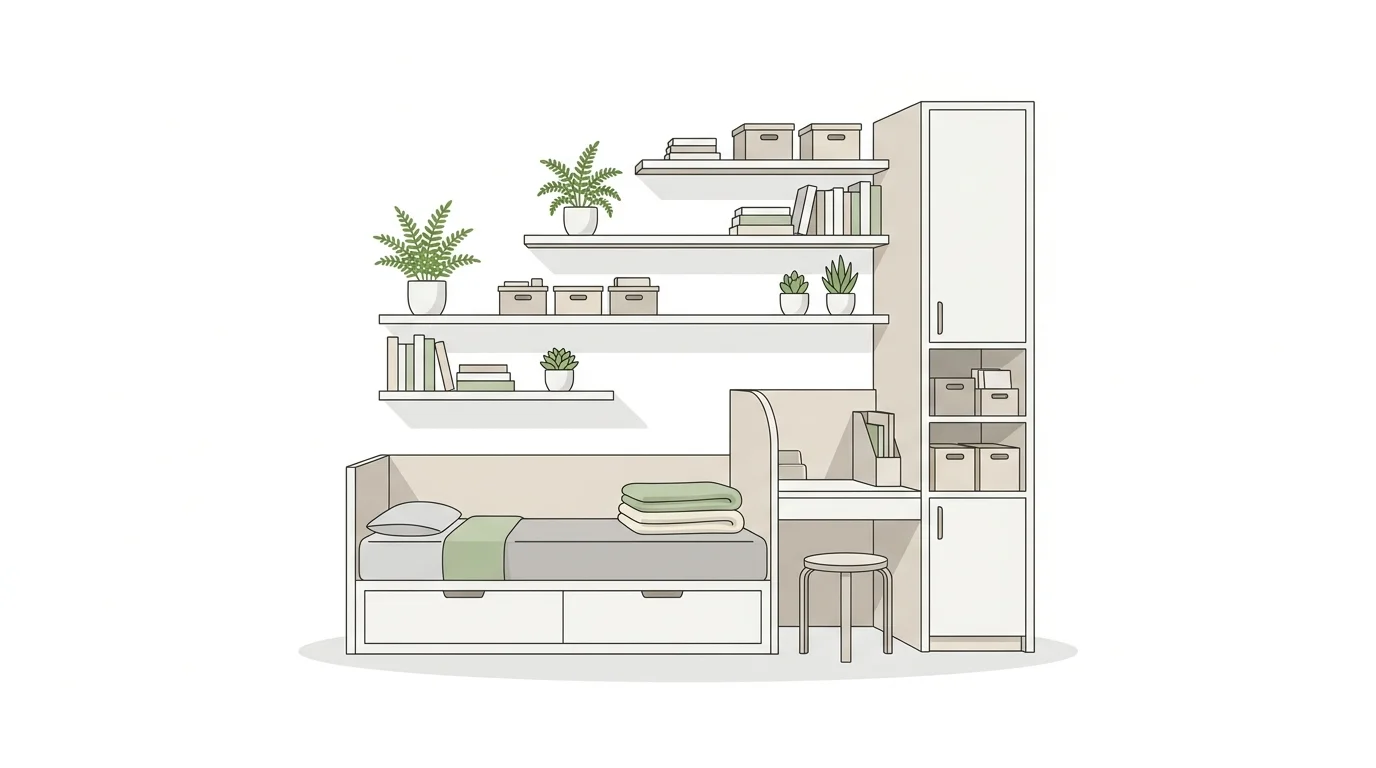
Living in a small apartment doesn’t mean sacrificing comfort or organization. With the right storage strategies, even compact spaces can feel open, functional, and easy to maintain. Research in environmental psychology consistently shows that visual clutter raises cortisol levels — the stress hormone — and makes it harder to concentrate or unwind. When your counters are piled high and every drawer is jammed, the apartment doesn’t just look messy; it actively drains your energy.
The good news is that smart storage isn’t about buying more stuff — it’s about rethinking the space you already have. A studio apartment with thoughtful organization can feel more livable than a two-bedroom filled with random furniture. The key is to think vertically, use multi-purpose furniture, and keep everyday items accessible without creating clutter. This guide walks room by room through practical, budget-friendly solutions you can implement this weekend.
Use vertical space efficiently
Walls are often the most underused real estate in small apartments. The average room has several feet of open wall space between the top of your furniture and the ceiling — space that could hold shelves, hooks, or organizers without consuming a single square foot of floor area.
Ideas for vertical storage
- Floating shelves for books and decor
- Wall hooks for bags, coats, and tools
- Hanging kitchen racks for utensils
- Tall shelving units instead of wide cabinets
Vertical storage keeps items visible and accessible while reducing visual clutter on surfaces. When you mount a row of hooks near the front door, for example, coats, bags, and keys have a permanent home — which means they stop migrating to chairs and countertops.
Choose multi-functional furniture
Furniture that serves multiple purposes is essential in small living spaces. Every piece of furniture that does only one job is a missed opportunity. Look for items that combine storage with everyday use, and you’ll effectively double the utility of your square footage.
Examples of smart furniture
- Beds with built-in drawers
- Storage ottomans
- Foldable desks or tables
- Sofas with hidden compartments
Kitchen storage solutions
The kitchen is often the most chaotic room in a small apartment. Counter space is precious, cabinets fill up fast, and oddly shaped items — colanders, cutting boards, pot lids — seem impossible to store neatly. A few targeted upgrades can completely transform how a small kitchen functions.
A magnetic knife strip mounted on a backsplash frees up an entire drawer and keeps knives sharp longer than a wooden block. Pair it with a small magnetic spice rack on the same wall and you’ve cleared significant counter space without any drilling into cabinetry. Inside cabinet doors are another overlooked surface: mount a wire rack on the inside of a lower cabinet door to store pot lids standing upright, and do the same with a shallow rack for cutting boards.
- Magnetic knife strips and spice racks mounted on walls
- Inside-cabinet-door organizers for lids and cutting boards
- Tension rods under the sink for hanging spray bottles upright
- Stackable shelf inserts to effectively double cabinet shelf space
- Lazy Susan turntables for deep corner cabinets so nothing gets lost
- Hanging fruit baskets suspended from the ceiling to free counter space
The tension rod trick under the sink is particularly effective: hang spray bottles from the rod by their trigger handles, and suddenly you have room beneath them for sponges, cleaning cloths, and dishwasher pods. It costs about two dollars and takes thirty seconds to set up.
Bathroom storage in tight spaces
Bathrooms in small apartments are notoriously short on storage, yet they need to hold towels, toiletries, cleaning supplies, and grooming tools. The trick is to maximize dead vertical space — especially the wall above the toilet, which is almost always wasted.
An over-toilet shelving unit (also called an etagere) can hold spare toilet paper, folded hand towels, candles, and small baskets for miscellaneous items — all without touching the floor or requiring any drilling. For the shower, a tension pole caddy that stands floor-to-ceiling is far more stable and capacious than a hanging caddy, and it won’t leave rust marks on your grout.
- Over-toilet shelving units to maximize dead vertical space
- Shower caddies on tension poles for shampoos and conditioners
- Recessed wall shelves as medicine cabinet alternatives
- Towel hooks instead of bars — they take less wall space and hold more per hook
- Under-sink rolling drawers that pull out like a cart
If you’re in a rental and can’t install a recessed shelf, a frameless mirror with a hidden compartment behind it is a renter-friendly alternative. It looks like wall art and holds a surprising amount of toiletries.
Bedroom storage without a big closet
A small closet — or no closet at all — is one of the most common frustrations in compact apartments. The solution is to expand storage into the rest of the room without making it feel cramped. Under the bed and behind the door are the two most productive places to start.
Rolling storage bins that slide under the bed work best when the bed is elevated with bed risers. A set of four inexpensive risers can add four to six inches of clearance, which is enough for standard storage bins. Use these for off-season clothing, extra bedding, or shoes. Vacuum storage bags take this even further — you can compress a full winter wardrobe into a surprisingly small package and slide it under the bed, freeing your closet for everyday wear.
- Under-bed rolling storage bins, elevated with bed risers for extra clearance
- Hanging closet organizers with fabric shelves for folded items
- Door-mounted shoe organizers (the clear-pocket style works for accessories, scarves, and belts too)
- A headboard with built-in shelving for books, a lamp, and small items
- Vacuum storage bags to compress seasonal clothing to a fraction of its size
Don’t overlook the back of the bedroom door. A multi-pocket organizer hung there can hold everything from shoes to scarves to your phone charger and reading glasses — items that tend to scatter across surfaces and create visual noise.
Organize by zones
Dividing your apartment into functional zones helps maintain order. Even in a studio, you can create clear areas for sleeping, working, and relaxing. The most important principle is that storage should live close to where items are used. Keeping your phone charger in a kitchen drawer because that’s where there’s space creates friction every morning — put it where you actually need it.
How to create zones
- Use rugs or lighting to define spaces
- Group similar items together
- Keep storage close to its usage area
Living room and workspace storage
The living room often doubles as an office in small apartments, which means it needs to serve two completely different functions without looking chaotic. Thoughtful storage choices let the space transition between roles without constant reorganization.
Floating shelves along one wall create display space for books and objects while keeping the floor clear. A wall-mounted fold-down desk is a genuine game-changer for remote workers — it folds flat against the wall when you’re done, making the room feel like a living space again rather than a home office. Pair it with a small stool that tucks underneath and you’ve created a full workstation that takes up zero space when not in use.
- Floating shelves along one wall for books, plants, and display objects
- Wall-mounted fold-down desk for remote workers who need a dedicated workspace
- Nesting tables instead of one large coffee table — spread them out when needed, stack them when not
- Cord management solutions like cable boxes and Velcro ties to eliminate visible wire clutter
- Ottomans with hidden storage compartments for blankets, board games, or extra cushions
Cable clutter is worth addressing specifically because it creates visual noise that makes a room feel messier than it is. A simple cable box — a small decorative box with a lid — hides your power strip and all the cables that connect to it. Combined with Velcro cable ties to bundle individual cords, it can transform the area behind your entertainment setup from a tangle of wires into something clean and manageable.
Declutter regularly
Storage works best when you don’t have unnecessary items. No amount of clever organization compensates for owning more than your space can comfortably hold. Regular decluttering is what keeps storage systems functioning — once a drawer is stuffed past capacity, the system breaks down and clutter spreads to surfaces again.
- Remove items you haven’t used in six months or more
- Donate or recycle unused belongings rather than moving them to another drawer
- Avoid overfilling storage spaces — leave 20% empty so things can be retrieved easily
Renter-friendly storage solutions
If you’re renting, the fear of losing your security deposit can make storage solutions feel off-limits. But a wide range of effective options require no drilling, no permanent adhesive, and leave zero marks when removed. You don’t have to live with bare walls and overflowing surfaces just because you rent.
Command strips and damage-free hooks have improved significantly in recent years. Quality versions hold up to 7 kilograms and remove cleanly by pulling the tab downward. Use them for picture frames, hooks, small shelves, and even towel bars. Tension rods work inside closets to create an extra hanging rail — useful for doubling your hanging space without altering the closet structure at all.
- Command strips and damage-free hooks rated up to 7kg for shelves and hooks
- Tension rods inside closets to add a second hanging rail for clothes
- Freestanding furniture (bookshelves, clothing racks, pantry units) instead of wall-mounted versions
- Removable adhesive shelves designed for bathrooms and tiled surfaces
Freestanding furniture deserves particular attention. A sturdy freestanding bookshelf can hold as much as a built-in without touching the walls. A freestanding clothing rack in a corner creates functional wardrobe space in rooms with no closet at all. These pieces move with you when your lease ends — which makes them a smart long-term investment rather than a compromise.
Use hidden storage spaces
Hidden storage is one of the most effective ways to maximize space in a small apartment. The goal is to make storage invisible — so the room reads as tidy and open even when it’s holding a significant amount of belongings.
Where to find hidden storage
- Under the bed with rolling bins or vacuum bags
- Behind doors with over-door organizers
- Inside furniture such as ottomans and storage benches
- Above cabinets in the kitchen for rarely used appliances
These areas allow you to store seasonal or rarely used items without affecting your daily living space. A small apartment with smart hidden storage can feel remarkably uncluttered — because everything has a place, and most of those places are out of sight.