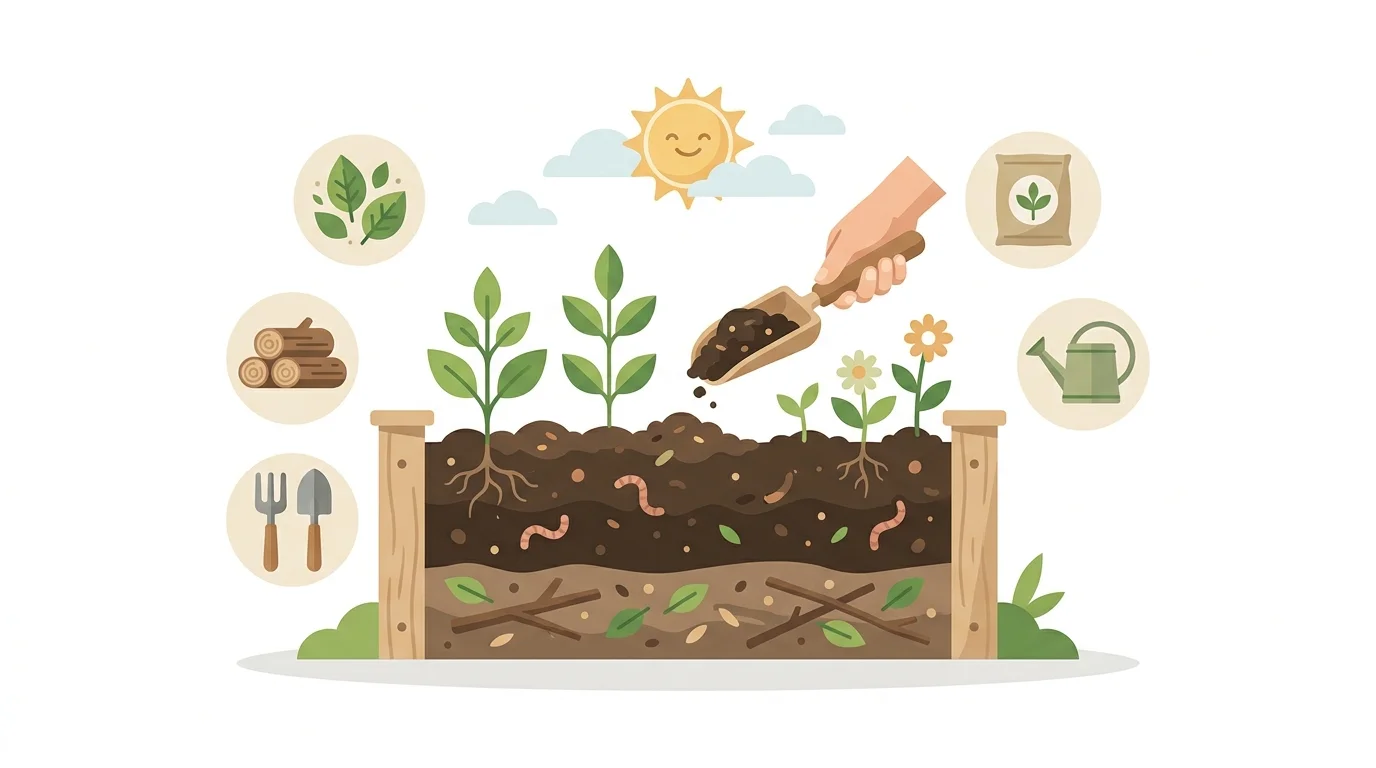
A healthy raised bed starts with the right soil mix. Unlike in-ground gardening, raised beds rely entirely on what you put inside them. That means soil structure, nutrient balance, and drainage all depend on your mix — there is no natural subsoil to fall back on.
In-ground soil benefits from decades of biological activity, earthworm channels, and layered mineral deposits. Raised beds skip all of that, which is both a challenge and an opportunity. You get to engineer the perfect growing environment from scratch, tailored exactly to the plants you want to grow. A well-built custom mix outperforms even premium bagged potting soil because you control the ratios, freshness, and organic content. Store-bought mixes often rely on peat moss alone, which breaks down quickly and compacts within a single season.
A well-built soil mix improves root development, prevents waterlogging, and supports long-term plant health. Whether you're growing vegetables, herbs, or flowers, getting this foundation right makes everything easier later.
Why soil mix matters in raised beds
Raised beds don't benefit from natural soil ecosystems in the same way ground soil does. This makes it important to create a balanced growing medium from the start. Roots in a raised bed are contained — they cannot push down through clay layers or seek out moisture deeper in the earth. Every centimeter of growth depends on what you provide. Good structure lets roots expand freely, which directly translates to bigger harvests and healthier plants.
- Better drainage prevents root rot
- Good structure supports root expansion
- Organic matter improves nutrient availability
- Loose soil allows easier planting and maintenance
The ideal soil mix formula
A simple and effective formula used by many gardeners is:
Basic ratio
- 40% topsoil
- 30% compost
- 30% aeration material (perlite, sand, or coco coir)
This combination creates a balanced mix that retains moisture while still allowing excess water to drain. The topsoil provides weight and mineral structure, the compost feeds the biology, and the aeration material keeps air pockets open so roots never suffocate.
Understanding each component
Topsoil
Topsoil acts as the structural base of your mix, providing mineral content and weight that keeps the bed stable. Look for screened topsoil that is dark in color, crumbles easily in your hand, and has no strong chemical smell. Avoid anything that feels slick or heavy when wet — that is a sign of clay content, which will compact over time and choke roots. If you source topsoil in bulk, check whether the supplier tests for heavy metals or contaminants, especially if you are growing food. A good-quality screened topsoil costs around $25–$45 per cubic yard and is worth every penny compared to cheap fill dirt.
Compost
Compost is the engine of your soil mix — it feeds the microbial community that in turn feeds your plants. Aged compost (dark, crumbly, earthy-smelling) is ideal; fresh compost can contain ammonia compounds that burn seedling roots. Mushroom compost is an affordable option that adds plenty of organic matter, though it can be slightly alkaline, so pair it with an acidic amendment if you are growing blueberries or strawberries. Worm castings are a premium upgrade: even 10–15% by volume dramatically improves plant vigor and disease resistance. Homemade compost from kitchen scraps and garden waste is the most cost-effective source of all, and after 6–12 months of aging it is just as good as anything you can buy.
Aeration materials
Perlite, vermiculite, and coarse sand each do the same basic job — keeping pore space open — but they behave differently in practice. Perlite is volcanic glass that is lightweight, permanent, and excellent at preventing compaction; it is the best all-purpose choice for most vegetables. Vermiculite holds more moisture than perlite, making it better for seed starting mixes or drought-sensitive plants, but it can break down over several years. Coarse builder's sand (never fine beach sand) adds weight and grit, which is helpful in shallow beds prone to tipping, but you need to add a lot of it — at least 20% by volume — to make a measurable difference in drainage. For most raised beds, perlite at 20–30% of your total mix gives the most consistent results.
Common soil mix recipes
Mel's Mix (classic Square Foot Gardening)
Developed by Mel Bartholomew for his Square Foot Gardening system, this three-way equal blend has proven itself over decades. Combine one-third peat moss or coco coir, one-third coarse vermiculite, and one-third blended compost — ideally from five or more different sources. The result is an extremely light, fluffy mix that drains beautifully and never compacts. It works best for intensive planting in shallow beds (20–30 cm deep) and is especially good for salad greens, herbs, and flowers. The main drawback is cost: coco coir and vermiculite in bulk add up, so this recipe suits smaller beds or gardeners who want a premium growing medium.
Budget mix for large beds
When you are filling a long raised bed — say, 1.2 by 2.4 meters and 30 cm deep — cost quickly becomes a real concern. A practical budget recipe is 50% topsoil, 30% compost, and 20% perlite. Buy topsoil and compost in bulk by the cubic yard from a local landscape supply yard; you will pay a fraction of the per-bag price. One cubic yard (about 0.76 cubic meters) is enough to fill roughly two standard 4-by-8-foot beds at 30 cm depth. Perlite in a large bag from a garden center rounds out the mix affordably. This recipe may need a bit more feeding mid-season since the lower compost ratio means fewer starting nutrients, but it performs reliably for most vegetables.
Premium vegetable mix
For heavy-producing crops like tomatoes, peppers, and cucumbers, a richer recipe pays dividends. Use 35% topsoil, 35% compost, 20% perlite, and 10% worm castings. The extra compost and worm castings create a nutrient-dense environment that sustains vigorous growth throughout a long season without heavy fertilizer inputs. You can also blend in a handful of slow-release granular fertilizer per square meter at planting time to give transplants an immediate boost. This mix costs more upfront but supports harvests that more than justify the investment.
Adjusting soil for specific plants
Root vegetables
Carrots, parsnips, beets, and radishes all need looser, deeper soil than most other crops. Aim for a bed at least 30–45 cm deep, and increase the sand or perlite fraction to 35–40% so roots can push straight down without forking. Any stones or woody debris in the mix will cause misshapen roots, so screen your topsoil carefully and avoid compost that contains large chunks. A sandier mix also dries out slightly faster, so pay attention to watering frequency during hot spells.
Herbs
Mediterranean herbs like rosemary, thyme, oregano, and sage evolved in lean, rocky soils and actually perform better with less compost. Reduce compost to 15–20% of your mix and boost perlite or coarse sand to ensure sharp drainage. Overly rich soil pushes herbs toward soft, floppy growth with diluted flavor. Basil is the exception — it enjoys more organic matter and consistent moisture, closer to the standard vegetable mix.
Heavy feeders
Tomatoes, squash, corn, and brassicas are nutrient powerhouses that deplete soil quickly. Beyond using a compost-rich mix (at least 30%), work a slow-release balanced fertilizer into the top 10 cm at planting time. Adding a handful of bone meal per plant at transplant time supports root establishment, and a side-dressing of compost or worm castings halfway through the season extends productivity well into autumn.
How to fill a raised bed affordably
Hugelkultur base layer
If you are building a deep bed (40 cm or more), the hugelkultur technique lets you fill the bottom third with organic material instead of expensive soil. Place logs, branches, and sticks at the base of the bed — the wood acts as a long-term sponge, holding moisture and slowly releasing nutrients as it decomposes over 3–7 years. Cover the wood with a layer of leaves or straw, then fill the upper two-thirds with your standard soil mix. The bed will settle slightly in year one as the wood begins to break down, so plan to top it up with compost in the following spring.
Lasagna layering
Lasagna layering (also called sheet mulching) is a no-dig method that works beautifully in tall raised beds. Alternate layers of nitrogen- rich "green" materials (grass clippings, kitchen scraps, fresh manure) with carbon-rich "brown" materials (cardboard, dried leaves, wood chips). Each layer should be 5–10 cm thick. Top the whole stack with 15–20 cm of finished soil mix. Over the first growing season, the layers break down and merge, creating deeply fertile soil by year two.
Sourcing bulk materials
The single biggest cost reduction comes from buying in bulk. Local landscape supply yards sell topsoil, compost, and wood chips by the cubic yard at a fraction of retail bag prices. Tree service companies often give away wood chips for free — call two or three and ask to be added to their drop list. Many municipalities offer free or cheap compost made from yard waste; check your local council's website. Perlite is the one material that is usually cheaper per bag at a garden center or agricultural supplier, since landscape yards rarely stock it.
Maintaining soil health over time
A raised bed's soil does not stay perfect on its own. Each growing season removes nutrients through plant uptake and leaching, and organic matter gradually breaks down, reducing total volume. The good news is that maintenance is simple and inexpensive if you keep up with it annually.
- Annual top-dressing: Each spring, spread 5–8 cm of finished compost over the surface of the bed and work it lightly into the top few centimeters. This replenishes nutrients and restores microbial life after winter dormancy.
- Cover crops: In the off-season, sow a cover crop like white clover, crimson clover, or winter rye. Clover fixes atmospheric nitrogen directly into the soil; winter rye adds bulk organic matter and suppresses weeds. Chop and turn the cover crop into the bed two to three weeks before you plant in spring.
- Watch for warning signs: Compaction, standing water after rain, pale or yellowing leaves, and slow germination all indicate soil problems. Compaction usually calls for a top-dressing of compost mixed with extra perlite. Pale plants often signal nitrogen depletion, which a compost application or liquid seaweed feed will quickly correct.
- Plan for settling: Expect soil volume to drop 10–15% per year as organic matter decomposes. Fill beds 5–8 cm above the rim at the start and budget for an annual top-up. Staying ahead of settling prevents the common problem of soil dropping below the bed walls, which encourages weed invasion and dries out the surface faster.
Common mistakes with raised bed soil
- Using only native garden soil: Straight garden soil compacts hard in a contained bed, cutting off airflow and drainage. Even good in-ground soil needs to be blended with compost and aeration material to work well in a raised bed context.
- Skipping organic matter entirely: A mix of topsoil and sand alone holds almost no nutrients and dries out rapidly. Compost is non-negotiable — it feeds the soil food web that in turn feeds your plants.
- Not accounting for settling: Many first-time gardeners fill beds to the brim and wonder why the soil looks sunken by midsummer. Always overfill by at least 10–15% and plan to top up each spring.
- Using pressure-treated lumber near edibles: Older pressure-treated wood contains arsenic-based preservatives that leach into soil. Even modern ACQ-treated lumber is controversial for food gardens. Use untreated cedar, redwood, or composite boards instead — they last 10–20 years without chemical concerns.
- Over-tilling: Repeatedly digging and turning your raised bed destroys the fungal networks and soil structure that take years to develop. Once your bed is established, switch to a no-dig approach: add amendments on the surface and let worms and microbes incorporate them naturally.
Layering vs mixing
While layering materials may seem easier, mixing everything evenly produces better results. Roots grow more consistently in uniform soil. If you layer without blending, you often create interfaces between materials where water pools or roots hesitate to cross. A thorough mix — even done by hand with a shovel and some elbow grease — gives you a uniform growing environment from top to bottom.
FAQ
Can I reuse soil next year?
Yes, but refresh it with compost and remove old roots. Top-dress with 5–8 cm of compost in spring and your bed will be ready to go again within a couple of weeks.
What if my soil holds too much water?
Add more aeration materials like sand or perlite. Work an extra 10–15% perlite into the top layer and check that your bed has adequate drainage holes or gaps at the base.
Is store-bought mix good enough?
It can work for a season, but custom mixes usually perform better long-term. Bagged mixes often contain high peat ratios that break down and compact quickly, requiring full replacement every year or two.